
Fun fact of the day:

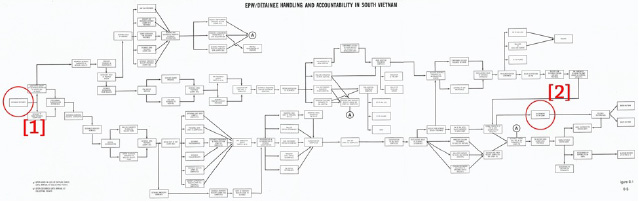
I'm writing a little bit today about language and the evolution of American prisoner of war doctrine. On a whim, I used the digital versions I've got here to scan the text for the keywords prisoner and detainee. In the 55 page FM 19-40 from 1964, the word prisoner appears 180 times, and detainee doesn't appear once. In the current Joint Doctrine JP 3-63 from May of 2008, which stands at 80 pages, the word prisoner appears twice as part of a sentence (28 times total in glossaries, treaty titles, etc.), while the word detainee appears a whopping 484 times. Just to keep myself honest, I searched for the acronym EPW—enemy prisoner of war—and it shows up 17 times, though only 10 in the text. This tops the total possible references to prisoners at 45—one quarter the number of times it appears in 1964.

There are lots of reasons to explain this, of course, and I am loathe to draw too many conclusions from soft quantitative information like this (or hard quants for that matter), but the juxtaposition between the two texts is nonetheless striking.

Today Stuart Elden posted a link to J.J. Cohen's really helpful post about getting research funding. It's good reading on a day when I received two rejection letters: it reaffirms the things that I think I'm doing right and frames quite nicely some things that I could do to help myself succeed. While I've recently been unsuccessful in my pursuit of a funded 2013, in my own personal longue durée (if such a thing could ever really be), I know that my batting average is fine and that I shouldn't be too discouraged.

While I feel both comforted and productively challenged by Cohen's post, it is important to note that even in a blog post about getting funding (something that would seem almost by definition to be a fairly mechanical procedure), Cohen manages to make the actual writing part of writing about applying for funding appear effortless. Consider this:

Write so that applying for fellowships is a way of doing scholarship rather than a potential waste of time. Write because your project deserves its best articulation, one through which (no matter what the fellowship outcome) its future will be more assured."

Your project deserves its best articulation. What an outstanding turn of phrase. It's not really hard to see why he gets the funding with prose like that…

As one of my committee members said today: keep firing away.

A shift I began to frame out a bit more fully today:


"Statement on Enemy Prisoners of War in the United States", Brigadier General B. M. Bryan, Jr., Assistant to the Provost Marshal General, April 26, 1945.

It is impossible to look at a man or talk to him and determine whether he is a Nazi, an anti-Nazi, or merely a German. Mistakes are made in the segregation program, the most outstanding of which occurred at Fort Devens, Massachusetts. At this camp about 1300 anti-Nazis were confined in one compound. After these men had been confined for approximately two months, four prisoners stated that they were Gestapo agents, that they had secured all the information they desired about the anti-Nazis in that compound and that they wished to be transferred to a Nazi prisoner of war camp. These four men are still at Fort Devens and are well subdued by the anti-Nazis."


Prisoner of War Command, A Study of the Administration and Security of the Oriental Communist Prisoner of War During the Conflict in Korea, 1953.

What’s weird about this is that it reads as if the Assistant to the Provost Marshal was having a laugh—that the internal politics of the camp were such that those kooky Gestapo would be kept in their place (even though there was often disorder and internal violence in the camps). But this cavalier attitude towards the identification and classification of detainee bodies would shift dramatically in less than ten years, so that these administrative processes would be seen as fundamental to the war effort in general. In a review of detainee operations in the Korean War, the POW Command would make this observation, that to maintain order:

“[p]ositive identification and documentation of communist PW must be initiated with prisoner number one.”

Doing some writing today about the organizational role of political identity and classification. I came across this passage with a haunting, beautiful turn of phrase at the end:


Derrida, J. 2006. The Politics of Friendship, 84.

Losing the enemy would simply be the loss of the political itself - and this would be our century's horizon after two world wars. And today, how many examples could be given of this disorientation of the political field, where the principal enemy now appears unidentifiable! The invention of the enemy is where the urgency and the anguish are..."

Oliver’s post today notes the remarkable degree to which the 1940 Small Wars Manual is laden with blatantly racist language. While on some levels (given the time period etc.), this is unsurprising, I’m drawn to the ways in which this military Orientalism contributed to a schizophrenic mentality of rule. He quotes the manual:

When composed largely of mixed races—that is to say, of individuals whose diverse heredities have dissociated their ancestral characteristics—those populations present a special problem. This class is always difficult to govern, if not ungovernable, owing to the absence of a fixed character.”

What is interesting to me is how this ‘difficulty’ that the population presents to military systems of legibility yields racial imaginaries that are so contradictory that they generate a feedback loop of inefficacy. I frequently come across notes and reports (especially from the 1950s to 1970s period) written by and about people who manage military detainment facilities in which they can’t seem to decide if those darned Orientals were so obsequious as to be dismissed or they were so fanatical as to only understand force (and extreme force at that).


U.S. Army, Pacific Command, June 1960, The Handling of Prisoners of War During the Korean War, 8.


Ibid., 20.

For instance, documents from the Korean War note that rumored events like the arrival of a train full of Chinese prisoners with no military escort reinforced an “attitude of complacency in regard to the docility of prisoners of war.” This was largely due to Asian “politeness and acquiescence to one’s host (captors?) or superior that is not present to the same degree in U.S. culture.” Yet, contradicting this assumed docility was the near simultaneous belief in the “uniqueness of the oriental Communist POW, a person whose indoctrination had been so thorough that capture and internment held no valid meaning.” The enemy culture was described as being as servile as its ideological underpinnings were fanatical.

The inability to translate between these two visions was a significant contributor to the confusion and mismanagement of the camps in Korea, which ultimately became violent extensions of the Cold War battlefield. While the rhetoric is in no way as unabashed as that of the Small Wars Manual, it nonetheless highlights a small piece of a puzzle that would see the military develop an array of techniques aimed at knowing the enemy through the increased use social scientists in Vietnam.

Update: 3 February 2012

Here are a few other winners I found in another source from the same time period:

“There was a sadism and brutality in many Orientals which was not common in men of better educated areas of the world”

...and...

“Their own lives were held so cheaply that they regard others’ the same way. The men were trained like dogs…”

A great sentence from the opening paragraph of John Cheney-Lippold's piece in December's Theory Culture and Society:

And somewhere, in a database far, far away, you very well may have a gender, class, and race."

I wonder to what extent the dialectical relationship between attack and defense that Virilio notes here has been changed by the spatial logics of security. It seems to me that while defense is still obviously a priority, it is no longer simply premised on a strategy of opposition, but it too has become absorbed into the logics of speed and circulation that typify security power:

Virilio,P. 1990. Popular Defense & Ecological Struggles, 15.

When the possibility of pastoral flight dis­appears with the advent of agricultural settlements and a change in the nature of wealth (non-trans­ portable goods), it is no longer enough to be quickly educated about one's surroundings; one must also educate the surroundings. In other words, one must try to preserve, on that very spot, one's head start over the enemy. Whence the con­struction, around the hillock, of protected enclaves, enclosures and fences intended to slow the ag­gressor down. Attack and defense then split on this terrain to form two elements of a single dia­lectic: the former becomes synonymous with speed, circulation, progression and change; and the latter with opposition to movement, tautologi­cal preservation, etc."

I start teaching tomorrow, and I'll be trying out a host of new things with the class. While I'm a bit nervous that some of them might not work, I feel like it's time to start trying to include my classroom in the discussions that circulates well beyond the four walls of our class. There will be a much more active use of twitter, and I'm going to try getting the class to post analyses to tumblr. It seems with a class with a title like 'Geographic Background to Current World Affairs' (I didn't name it...), I have to double down on establishing the importance of 'the spatial' in my students' understandings of their lives. We'll see how the conversation unfolds, but I am excited to be able to ground the syllabus in a contemporary framework.

Beyond that, there's that small task of finding a job for next year and finishing up the dissertation. The drive to the finish starts tomorrow. Gulp.

Ten years ago, there was no kid. My wife of five years and I had not started dating (though not for lack of trying on my part). My world was pretty much defined by late nights in the architecture office and later nights trying to figure out what role I was playing in the city’s social scene. Two parents could still tell me they were frustrated by my inability to return a phone call. I was not in graduate school, had never taught a class, and didn’t think of myself as a geographer or social scientist. I had never lived in Paris or Iowa. I had spent no time in Ireland or Northern Ireland, and I never thought I would. No bike tours were logged in my legs. My cell phone looked like a giant, un-shucked oyster and could only vaguely approximate the act of what you might term a telephone call. I had lots and lots of hair.

Lots.

Memory, anxiety, and responsibility may all make it pretty easy to imagine a small decade—the brain casts off most things into oblivion and we see only the peaks and valleys and the stuff that makes it onto our new facebook timelines—but these ten years have seen a lot of personal change, growth, loss, and exploration. In this, I am not very special. People change. Objects change. Connections change. So what?


See this for a description of the force feeding process.

Today, though, I can’t stop thinking about the past ten years. January 11, 2012 marks the tenth anniversary of the opening of the Guantánamo Bay detention center. They are (again) hunger striking, as the only agency they have is over their own biological processes, though the state has even developed an apparatus to intervene in this. What a weird, awful anniversary for the 171 people still sequestered in limbo.

My doctoral research deals with, at least tangentially, this legal lacuna, but it is through a historical and technical lens that by and large abstracts the analyses towards the ‘scientific’. I explore the suite of technologies that have emerged that are designed to conjure bodily and spatial control in the chaos of war in new ways. I look at detention through the prism of archives and articles, things and theories. Despite the fact that my dissertation describes things with vectors tracing across 20th century war and through the island camp at Guantánamo, it doesn’t necessarily engage with what that might mean as part of an individual’s life. It's impossible to imagine what ten years would feel like for someone who isn't even given the opportunity to know how long they will be detained for, or, as is true for over 80 Guantánamo detainees, that they are in fact detained for nothing. For this, though, I gain some perspective about what ten years might mean by thinking about my life in those ten years, and then imagining it not being there in any way, but that I still was. My life as it stands today would be unrecognizable to the 24 year old architect.

Some might scoff at the idea that someone humanize the narrative of these, the so-called worst of the worst. Why would I even want to allude to the things that these detainees might have done in the ten intervening years? Don’t forget, some say, about the awful conditions caused by administrative detention in Yemen, China, Israel, or France. Comparatively, Cuba is a cake-walk. What about the millions of detainees in World War II? 171 seems like a pretty small number to get worked up about. Even if one were to accept these criticisms, we’d do well to remember that at its root, the Enemy Prisoner of War is an extremely complicated phenomenon in the history of the liberal state.

In The Social Contract, Rousseau frames the relationship between killing and detaining as if it isn’t problematic, as if the simple act of putting down a weapon erases the volatility that comes with the status ‘enemy’: “The object of the war being the destruction of the hostile State, the other side has a right to kill its defenders, while they are bearing arms; but as soon as they lay them down and surrender, they cease to be enemies or instruments of the enemy, and become once more merely men, whose life no one has any right to take…”

In many cases, as with most still detained in Cuba, the line between political prisoner and POW, between capture on and off the battlefield is not clear. They are not (necessarily) criminals, though they are often imagined and referred to as such. There is no legal system, no clear law that applies everywhere. They are a remainder of war; often seen as war’s leftovers, though many military tactics are designed with the express purpose of generating detainees and not killing people. Yet the physical management of their bodies reveals a central fault line in the foundations of liberal war: making detainees means making someone’s body—often an enemy body that you would otherwise be trying to kill—subject to care. Biopolitics to the core. If we are to care, then we should perhaps try to recognize that this comes with a great deal of complexity, and though easy answers are lacking, it is of great importance to try to uncover them. Just because there are fewer detainees, doesn't make the issue less pressing. Just because it's worse elsewhere doesn't excuse the wild injustices of our own making.

Ten years is a really long time in a life.

Here's a quote from Julian Assange in this month's Harper's:

"So we need a way of consistently and accurately naming every piece of human knowledge, in such a way that the name arises out of the knowledge itself, out of its textual, visual, or aural representation, where the name is inextricably coupled to what it actually is. If we have that name, and if we use that name to refer to some information, and someone tries to change the contents, then it is either impossible or completely detectable by anyone using the name."

I wonder what Foucault, circa The Order of Things, would have to say about this...

«  Older Posts